


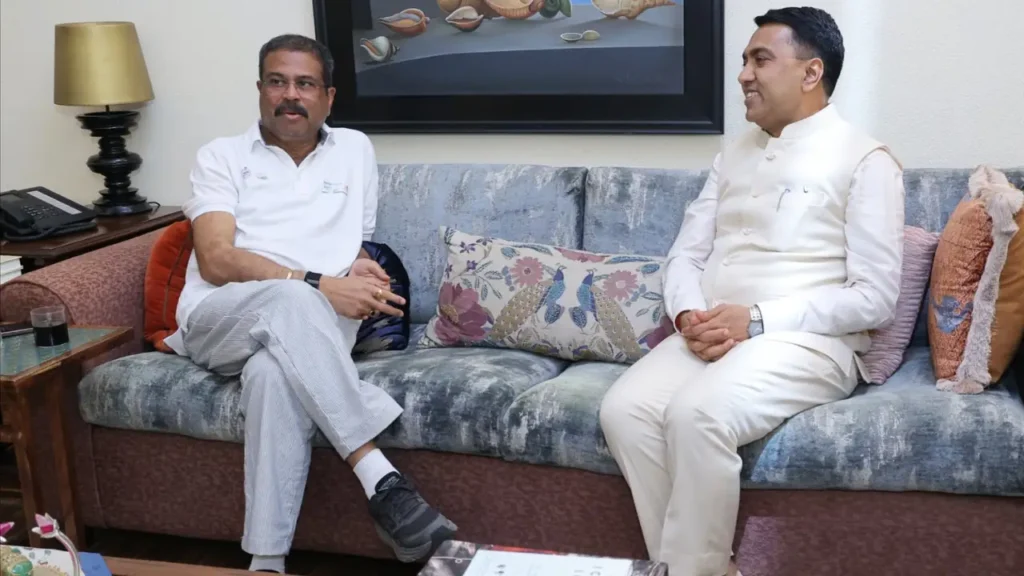
Union Education Minister Dharmendra Pradhan met Chief Minister Pramod Sawant on Sunday and discussed the implementation of the National Education Policy (NEP) 2020 in Goa, with a focus on strengthening education outcomes and expanding skill development opportunities for young people in the state.
Following the meeting, Pradhan said the discussions centred on improving the rollout of the education policy and enhancing opportunities for youth through skilling initiatives.
“Pleased to meet Chief Minister of Goa, @PramodPSawantJi. Had fruitful discussions on strengthening the implementation of #NEP2020 and expanding skilling opportunities for the youth of Goa,” Pradhan said in a post on X.
Pleased to meet Hon'ble Chief Minister of Goa, @DrPramodPSawant Ji.
— Dharmendra Pradhan (@dpradhanbjp) June 7, 2026
Had fruitful discussions on strengthening the implementation of #NEP2020 and expanding skilling opportunities for the youth of Goa.
Looking forward to our continued collaboration in advancing quality education… pic.twitter.com/5mYKqOBxOW


“Looking forward to our continued collaboration in advancing quality education and developing the human resources of the State effectively,” he added.
The National Education Policy 2020 serves as India’s framework for reforming the education sector. The policy is built around the principles of access, equity, quality, affordability and accountability. It introduced measures such as multidisciplinary learning, vocational integration and greater academic flexibility.
 © x.com/dpradhanbjp
Earlier in the day, Pradhan also held discussions with Vice-Chancellors of Central Universities to review the progress made in implementing NEP 2020 and to assess future strategies aligned with the vision of Viksit Bharat 2047.
Addressing the university heads, the Union Minister said India’s higher education system had undergone significant changes over the past decade, becoming more flexible, interdisciplinary, inclusive and innovation-driven.
Pradhan said total student enrolment had reached 4.46 crore, representing a 30 per cent increase since 2014-15. He added that female enrolment had grown by 38 per cent and that the female Gross Enrolment Ratio now exceeded that of males.
He further stated that Ph.D. enrolment had nearly doubled, while the number of female Ph.D. scholars had increased by 136 per cent. According to the minister, enrolment indicators among Scheduled Tribe and Scheduled Caste communities had also shown improvement, reflecting efforts towards inclusive education.
Leave a Reply