



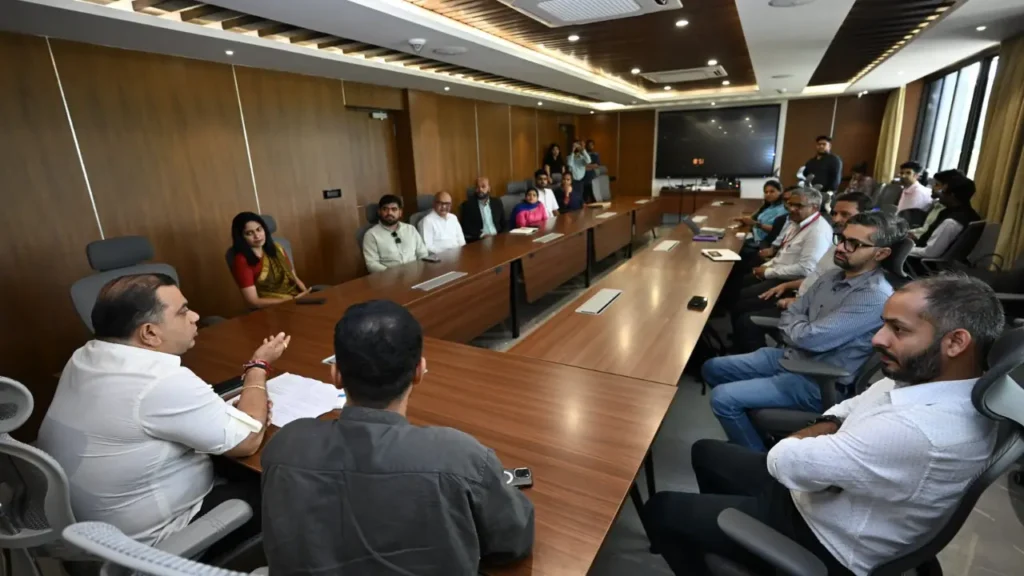
When the Honourable Minister for Information Technology, Electronics and Communications, Rohan Khaunte, unveiled the Draft Goa Artificial Intelligence Policy 2026 at Paryatan Bhavan on May 4, the headline he chose was speed: a framework delivered in fifty days against a hundred-day commitment. That was the right thing to celebrate. State-level AI policy is rare. Well-drafted state-level AI policy is rarer still. Goa now has one of the cleanest regulatory frameworks any Indian state has produced on this subject.
That deserves recognition before any criticism begins.
The team at the Department of Information Technology, Electronics and Communications (DITE&C), led by Director Kabir Shirgaonkar with Joint Director Dr. Milind Sakhardande and Startup and IT Promotion Cell CEO D.S. Prashant, conducted a serious consultation with industry and academia between the first internal draft and the version released last week. The earlier draft was an aspiration document. This one is closer to an implementation framework. The four-tier risk classification, the entire Section 10 on deepfakes, the mandatory AI Impact Assessments for high-risk systems, the regulatory sandbox for startups, the Green AI commitments, the partnership-based compute model: each of these is something the previous draft did not have, and that the draft opened to the public now does.
What follows here is not a question of whether the work is serious. It clearly is. However, there still are serious questions and choices, the work has yet to fully resolve.
 © x.com/RohanKhaunte
Why this matters for Goans
It is tempting to treat a forty-three page government policy as a technical exercise. This one is not. Over the next three to five years, this policy will decide whether AI in Goa works with Goans or works on them.
It will decide whether the welfare schemes that thousands of Goan families depend on continue to be approved by humans who can explain their reasoning, or whether decisions get made by algorithms whose logic no one in the department understands. It will decide whether a fisherman in Cutbona gets an accurate weather and fishing-zone advisory in Konkani through public infrastructure, or pays for a private app that ships his data to overseas servers. It will decide whether a Class IX student in Sanguem learns AI from a trained teacher in a properly equipped lab, or from a one-week orientation and a borrowed laptop. It will decide whether the Konkani Large Language Model becomes shared cultural infrastructure that Goan founders can build businesses on, or a closed product that gets licensed back to Goans by whoever holds the rights.
These are not technical questions. They are decisions about what kind of state Goa becomes in the AI era.
The draft frames all of them well. It answers few of them. The substance, in almost every case, is deferred to schedules and committees that do not yet exist. Once the policy is notified, those defaults harden, and they harden in the direction of whoever sits at the table when the schedules get drafted. The fifteen-day public consultation window closes on May 19, and what gets written in is what citizens can push for now.
Five questions deserve sustained public attention.
1. The Risk Classification Schedule does not exist yet
Section 4.4 establishes a four-tier system: Prohibited, High-Risk, Medium-Risk, Low-Risk. The text gives example categories (social scoring, untargeted biometric scraping, healthcare triage, welfare eligibility), but the actual binding list is “to be published” by a Goa AI Authority that has itself not yet been constituted. Phase 1 of the implementation timeline aims for December 2026.
This is where the real lobbying will happen.
Take the example named in the policy itself: emotion recognition AI is prohibited “in education or workplace settings for routine monitoring.” That language sounds firm until you ask what counts as routine. A school deploying AI cameras for “early dropout intervention”, explicitly listed in Pillar III as a permitted use, is in technical terms doing emotion and behavioural inference on minors. Whether that falls inside the prohibition or outside it depends on how the schedule is drafted. Drafted in a closed committee with industry vendors providing input and schools wanting cheaper truancy monitoring, the line gets drawn one way. Drafted with parent associations and child rights organisations in the room, it gets drawn another way.
What public feedback should ask for: a draft Risk Classification Schedule published during the consultation period itself, not after notification. The list is the policy.
2. “Human oversight” is the load-bearing concept and it is undefined
Pillar III mandates human oversight in welfare, healthcare, and law enforcement applications. Section 6.6 adds that “AI shall not serve as the sole basis for any adverse administrative decision; human review and explanation are mandatory.”
There are at least three different regimes that all answer to the words “human oversight,” and they produce different accountability stories.
The first is reviewer mode: a human reads every individual decision the AI produces and signs off before it becomes binding. This is what most citizens imagine. It is also operationally impossible at scale. A welfare scheme processing fifty thousand applications a year cannot have a human review each one with substance.
The second is supervisor mode: the AI processes everything, and a human samples a percentage of decisions, looks for systemic drift, and audits patterns. This is what most regulators around the world end up settling for. It catches systematic bias but lets individual errors slip through.
The third is sign-off mode: a human approves the model’s design and deployment, then steps back. The AI runs autonomously after that. This is what vendors prefer because it minimises operational cost.
Three regimes. Three liability profiles. Three different stories about who is responsible when the AI gets a citizen’s benefit eligibility wrong. The Goa draft picks none of them.
What public feedback should ask for: a working legal definition of “human oversight” before notification, with binding standards for at least the welfare, healthcare, and law-enforcement use cases. Without it, every department will pick the cheapest interpretation.
3. The Konkani LLM is described as open-source. Under what license?
The Konkani Large Language Model is the policy’s strongest cultural commitment, and its most quoted talking point. The draft anchors it in a formal MoU with BHASHINI and references AI4Bharat’s IndicTrans2 (which already covers Konkani among twenty-two scheduled Indian languages under an open license), along with NIELIT Manipur’s low-resource-language work and IIT Kanpur’s translation systems.
What the draft does not say is what “open-source” means in this specific case.
There are at least four possibilities. One: the model weights are released under a permissive license such as Apache 2.0 or MIT, allowing anyone to fine-tune and ship commercial products on top. Two: only the weights are released, but the training corpus stays proprietary, which limits what downstream developers can verify or improve. Three: it is released under a research-only or non-commercial license, which would block Goan startups from building businesses on it. Four: it is released as a hosted API with rate limits, which is “open access” but not “open-source.”
Each of these has substantially different consequences for whether a founder based in Margao, building a Konkani-language tourism chatbot can actually use the LLM as infrastructure, or whether they end up paying a vendor for access to what was supposed to be public infrastructure.
What public feedback should ask for: explicit licensing terms named in the policy itself, with a published target release date and a publicly accessible corpus governance model. AI4Bharat’s IndicTrans2 (MIT license) is already cited as a technical reference. The license model can be cited too.
4. The Advisory Council needs both civil society and deep AI expertise
This is where I think public feedback should push hardest.
The Goa AI Advisory Council, set out in Section 7.1, is chaired by the Chief Minister, vice-chaired by the IT Minister, and populated by senior bureaucrats, vice-chancellors of IIT Goa and NIT Goa, three industry association representatives, two startup representatives, the State Chief Data Officer, and “two representatives including at least one woman and one representative from a marginalised community.”
Two gaps in this composition matter, and both need to be addressed in the public feedback.
The first is civil society. The Council, as constituted, has substantial bureaucratic representation, substantial industry representation, no consumer rights advocates, no representatives of welfare beneficiaries who will be subject to AI-driven eligibility decisions, no teachers’ associations, no fisherfolk cooperatives, no tourism workers’ unions. The two “diversity” seats look performative against thirteen other seats with defined institutional standing. A Council that does not include the people who will be regulated by AI deployments cannot make decisions that those people will trust.
The second gap is more uncomfortable to name, because it concerns expertise. None of the current seats are reserved for people with a proven hands-on AI track record. Vice-chancellors are academic administrators, not always practitioners. Industry association representatives are advocates, not engineers. Startup representatives are founders, and founder is not a synonym for AI expert. The Council will be asked, repeatedly, to make consequential decisions about model risk, deployment design, oversight standards, and procurement criteria. Those decisions need people in the room who have actually trained models, deployed them in production, watched them fail in unexpected ways, and been forced to fix them. That is a different skill set from running an institution or representing a sector.
Goa has those people. Researchers at BITS Pilani Goa, Goa University, and Goa Institute of Management work on applied machine learning. Goan founders at companies large and small, who ship AI in production every day. Members of the Goan technology diaspora hold senior positions at AI labs in Europe, the United States, and Israel, and several of them maintain active ties with the state. None of them have a defined seat at this table.
What public feedback should ask for: at least three additional Council seats. One for civil society, one for sectoral worker representation, and one for a recognised AI practitioner with a published or commercially deployed track record. The cost of these seats is a quarterly meeting allowance. The cost of not having them is a Council that will rubber-stamp whatever the secretariat puts in front of it, and a policy whose implementation gets driven by lobbying rather than by evidence.
5. Rural Goa is set to receive a thinner version of the same AI rollout
Pillar I commits to AI as a compulsory subject in Classes VI through XII by Academic Year 2027–28, AI Laboratories in 50 government schools, and 500 teachers trained in AI pedagogy.
The official numbers from UDISE+ 2023–24, the Ministry of Education’s annual school-level statistics, place Goa at 1,487 schools and 14,594 teachers across the state. Those fifty AI labs work out to 3.4 percent of schools. Five hundred trained teachers work out to 3.4 percent of the teaching workforce. The compulsory curriculum, by contrast, applies to one hundred percent of schools.
That gap will not be closed evenly. Panaji has the infrastructure, the private-school competition pressure, the parent demand that pulls AI labs in first. Margao and Vasco follow. Sattari, Canacona, Sanguem, Pernem do not. A Class IX student in a private school in Porvorim will get a structured AI curriculum taught by a trained teacher in a properly equipped lab. A Class IX student in a government school in Sanguem will get the same syllabus, taught by a teacher who attended a one-week orientation, in a classroom with one shared computer and unreliable internet.
That is not AI lifting up the state evenly. That is AI accelerating a divide that already exists between Goa’s urban-coastal core and its rural-eastern interior.
What public feedback should ask for: rural-first allocation of the 50 AI labs (target at least sixty percent in talukas with the lowest existing computer-facility coverage), Konkani-medium teaching materials as a hard requirement rather than an aspirational mention, and mobile AI lab rotations across smaller schools that will not get a permanent installation. The policy talks about inclusion. The numbers, as currently written, work against it.
What needs to be done by May 19th
A good AI policy is not a finished product. It is a starting point that gets filled in by everyone with a stake in how AI shapes the state. The DITEC team has done the hard work of getting the architecture right. The harder work, which begins now, is filling that architecture with content that protects Goans rather than processes them.
The fifteen-day window is the only structured opportunity for citizens to influence that content before it gets locked in. After May 19, the writing happens in committee rooms with closed doors.
Send substantive feedback to [email protected]. Cite the specific section numbers. Ask for the things above, or ask for the things you actually need from this policy as a parent, a founder, a fisherman, a teacher, a tourism operator, a public servant. The Government has explicitly invited engagement, and a serious public response is the best signal we can send that this consultation is not a formality.
What is at stake is not an abstract regulatory framework. It is the question of whether AI, over the next decade in Goa, becomes a tool that serves Goans, or one that they end up serving.

Leave a Reply