



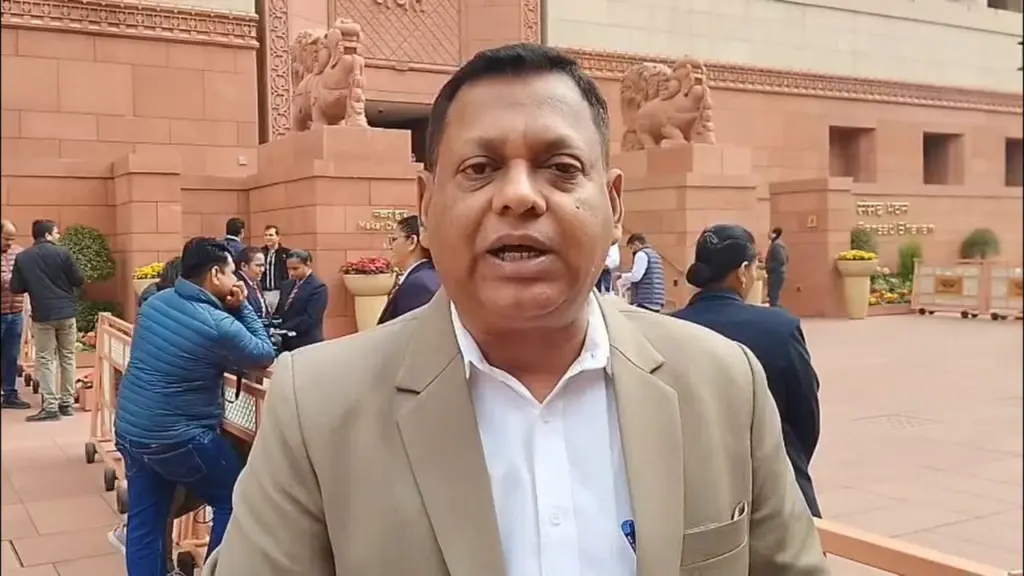
The flyover under construction near Dabolim Airport came under intense scrutiny in the Lok Sabha on Thursday, the opening day of the Budget Session, after South Goa MP Captain Viriato Fernandes alleged serious procedural violations and threats to aviation safety linked to the project.
Raising a starred question, Captain Fernandes accused the National Highways Authority of India and the Ministry of Road Transport and Highways of disregarding mandatory safety norms while executing the flyover. He alleged that the agencies failed to follow statutory procedures required for construction in the vicinity of an operational airport.
The MP told the House that no No Objection Certificate (NOC) was obtained from the Indian Navy for Obstacle Limitation Surface clearance, a requirement mandated under a Ministry of Civil Aviation Gazette notification dated September 30, 2015. He warned that bypassing this clearance posed risks not only to civilian aircraft operations but also to defence aviation.
What Are Obstacle Limitation Surface (OLS) Norms?
Obstacle Limitation Surface (OLS) norms regulate the height and placement of structures in the vicinity of airports to ensure the safe movement of aircraft during take-off and landing.
These norms are enforced through mandatory clearances from aviation authorities and, in the case of Dabolim Airport, also require approval from defence authorities due to shared civilian and military operations.


Any construction that breaches OLS limits can restrict aircraft operations, pose safety risks, and require corrective structural modifications, often at significant public cost.
Captain Fernandes further alleged that the flyover was not conceived in public interest but was intended to facilitate the transportation of coal from the Mormugao Port Authority to neighbouring states, allegedly to benefit the Adani Group. He claimed that infrastructure planning and safety considerations were compromised to serve private commercial interests.
According to the MP, officials of the NHAI repeatedly failed to disclose project details to the Indian Navy despite multiple directives. He informed Parliament that it was only after concerned citizens approached the Bombay High Court that the highway authority was compelled to seek the required naval clearance.
This intervention, he said, led to corrective measures, including the trimming of 17 flyover pillars and a reduction in the structure’s height to ensure the safety of approaching aircraft. Captain Fernandes argued that these changes confirmed serious lapses in planning and execution.
He alleged that the avoidable modifications resulted in substantial financial losses to the public exchequer and demanded that responsibility be fixed on officials responsible for the violations and wastage of public funds.
Dissatisfied with the initial reply from the Minister of State for Road Transport and Highways, Captain Fernandes pressed for a supplementary question, which was admitted by the Speaker, Om Birla. Using the opportunity, the MP urged that accountability be enforced against erring officials for breaching aviation safety norms.
Reiterating his allegations, the South Goa MP maintained that the flyover’s primary purpose was to enable coal transportation rather than address the genuine infrastructure needs of Goa. He asserted that safety regulations, transparency, and public interest could not be subordinated to benefit powerful corporate entities.
The issue has intensified debate over infrastructure development near operational airports, drawing renewed attention to regulatory compliance, public spending, and aviation safety in Goa.
Leave a Reply