



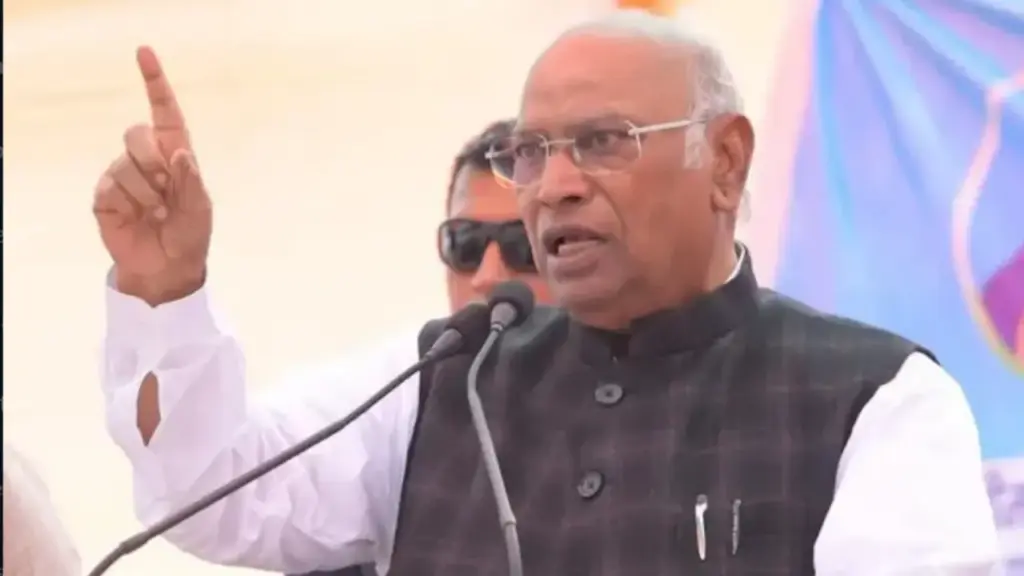
Congress president Mallikarjun Kharge on Saturday outlined three key demands under the party’s “MGNREGA Bachao Sangram”, asserting that the rural employment scheme was “not a charity but a legal guarantee”.
Kharge said the Congress was demanding that the Centre withdraw the recently enacted Viksit Bharat – Guarantee for Rozgar and Ajeevika Mission (Gramin) Act, restore the Mahatma Gandhi National Rural Employment Guarantee Act as a rights-based law, and reinstate the right to work along with the authority of Panchayats.
“MGNREGA is not charity. It is a legal guarantee. Crores of poorest people got work in their own villages; MGNREGA reduced hunger and distress migration, raised rural wages, and strengthened women’s economic dignity,” Kharge said in a post on X.
He alleged that the VB-G Ram G Act threatened to dismantle the rights-based framework of MGNREGA by replacing guaranteed employment with discretionary provisions, centralising control, and weakening Gram Sabhas and states.
According to Kharge, the new law would cap budgets, limit guaranteed work to selected Panchayats, and allow denial of work during periods of distress. He further claimed that the requirement for states to fund 40 per cent of the scheme would weaken federalism and disproportionately affect poorer states, while technology-driven processes could exclude workers through biometric and app-based barriers.
“Attacking MGNREGA is attacking crores of workers and their constitutional rights. We will resist, peacefully and firmly, from every Panchayat to Parliament,” Kharge said.
The remarks come after the Congress announced a nationwide three-phase agitation against the VB-G Ram G Act. Addressing a press conference in New Delhi, Congress general secretaries K. C. Venugopal and Jairam Ramesh accused the Centre of attempting to centralise the employment guarantee scheme and acting arbitrarily.
As per the party’s plan, Phase 1 of the agitation will begin on January 8 with preparatory meetings at Pradesh Congress Committee offices, followed by district-level press conferences on January 10 and a one-day fast at district headquarters on January 11. Phase 2 will run from January 12 to January 30 with panchayat-level chaupals and outreach programmes. Phase 3 will commence on January 31 with district-level dharnas, followed by state-level protests and zonal rallies through February.
Leave a Reply